Verified Research
Aug 27, 2026
Dogs Blink Back at Other Dogs. Whether They Do It For You Has Not Been Tested.
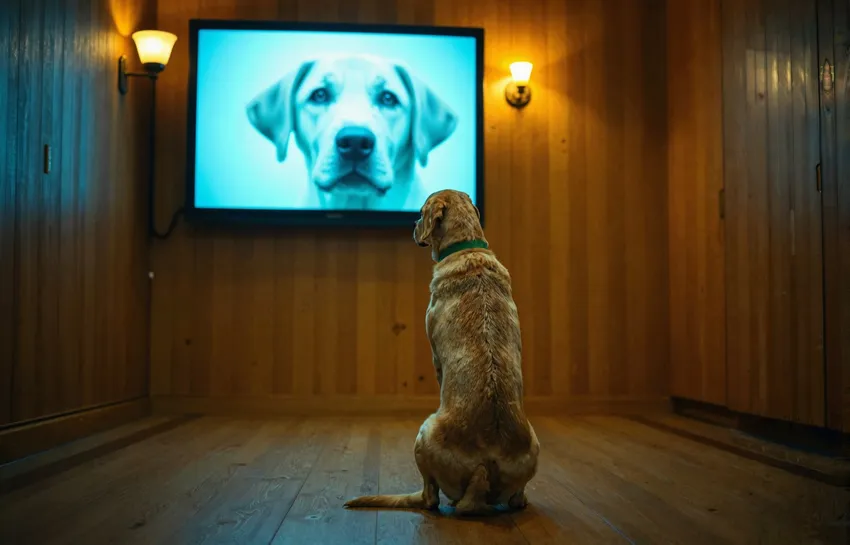
This is not one of ours.
The Malarkey Institute publishes findings it invents. Occasionally somebody does the work properly, and the result is stranger than anything we would have had the nerve to fabricate. This is one of those, and we are reporting it straight.
In February 2025, Chiara Canori and colleagues at the University of Parma published a study in Royal Society Open Science with the best title we have read all year: “If you blink at me, I’ll blink back.” The question was simple. If a dog watches another dog blink, does it blink too?
It does.
What They Actually Did
Fifty-four dogs were recruited — 30 females, 24 males, aged between one and twelve. All were mesocephalic breeds of medium to large size, which is a polite way of saying no pugs and no chihuahuas: you cannot reliably score the facial movements of a dog whose face is a different shape from the reference model.
Each dog watched three 71-second videos of unfamiliar dogs:
- one of dogs blinking
- one of dogs licking their noses — another common canine signal, included so the comparison isn’t simply “movement versus no movement”
- one of dogs looking attentively at the camera, doing nothing in particular
The watching dogs were filmed. Their blinks were then coded using DogFACS, the canine version of the Facial Action Coding System — blinking is action unit AU145 — by two certified coders working independently, agreeing with each other at an ICC between 0.71 and 0.92.
By The Numbers
What They Found
Dogs blinked more while watching the blinking video than while watching the nose-licking video. The reported estimate is 0.250 ± 0.101, at p = 0.035.
Against the attentive-still control, the difference pointed the same way but did not reach significance — the authors report it as a trend, at p = 0.071.
That is a real result and a modest one, and we would rather say so than round it up. It is one comparison clearing the conventional threshold and one not quite clearing it, in a sample that started at 54 dogs and ended at 47 once exclusion criteria were applied.
The heart-rate measurements are worth a separate note, because they answer a question you might reasonably have. Measures of heart rate variability — SDNN, RMSSD, pNN50 — were higher after the test than at baseline regardless of which video was shown. The dogs were not stressed by any of it. Whatever blinking back is, it is not distress.
Only 23 of the 54 dogs produced usable cardiac data. The equipment malfunctioned. The authors say so plainly, which we mention because a fake institute notices when a real one admits something.
“Eye blinking seems to support non-verbal social communication,” the authors write, and reciprocal blinking “might help to facilitate conspecific social bonds.”
The Part Everybody Skips
The word doing the most work in that sentence is conspecific. It means within the same species.
Every dog in this study was watching a video of another dog. Not a person. Not its owner. The finding is that dogs blink back at dogs.
The version you are already thinking about — that your dog blinks back at you, that the slow blink you have been exchanging across the room for years is a conversation — is not what was tested here. It is not supported by this paper and it is not refuted by it. It simply was not the experiment.
The authors are direct about the limits. Blink synchronisation, they note, “was not directly addressed in the present study,” and they call for future work on how blinking and nose-licking shape social interaction.
So the honest position is this: there is now decent evidence that blinking carries social information between dogs, and an obvious, entirely untested question sitting immediately next to it.
Why This Is Filed Here And Not With Our Findings
We publish invented research. It is clearly labelled as invented, at the bottom of every article, and the labelling is the only thing that makes the joke ethical rather than merely convenient.
That commitment cuts both ways. When the subject is real, attaching our usual disclaimer would be a lie in the opposite direction — printing “none of this is true” underneath a peer-reviewed paper that is. So real work goes here instead, under its own heading, with its sources listed and nothing invented in between.
The Institute did not conduct this study, has no relationship with the University of Parma, and contributed nothing to it beyond reading it.
We simply liked it, and it is true, and those turn out to be different reasons.
Sources
Grow Your Confidence,
Not Your Doubts
Subscribe to receive the Institute's latest unverified findings the moment they exist, and well before the fact-checkers arrive.