Verified Research
Aug 31, 2026
Blind Mice Found the Dark Again, in Ordinary Room Light
This is not one of ours, and we want to be unusually careful with it.
The Malarkey Institute invents its findings. This one belongs to a consortium led by the Institute for Bioengineering of Catalonia, and it concerns people who are losing their sight, so we are going to report exactly what was done and exactly what was not.
In July 2026, in the Journal of the American Chemical Society, Pau Gorostiza, Rosalba Sortino, Pedro de la Villa and colleagues described a molecule that changes shape when light hits it. Put it into a blind retina and the retina starts responding to light again.
The mice began avoiding brightness. They had not done that in some time.
What They Actually Did
The compounds are called prosthe6 — a prosthesis for mGlu6, the receptor they act on. They sit on the ON bipolar cells, one layer inward from the photoreceptors that these diseases destroy. The photoreceptors are gone; the wiring behind them is not. The molecule gives that surviving wiring something to respond to.
When light strikes it, it changes shape, and the change propagates as a signal. The authors describe the result as closely resembling the way the retina normally works — not a substitute display, but the existing circuit given a new front end.
Two animal models were used: zebrafish larvae, and mice bred to model age-related macular degeneration and retinitis pigmentosa. Between them those two conditions account for a large share of degenerative blindness worldwide.
By The Numbers
What Came Back
In the zebrafish, the optokinetic reflex — the flick of the eyes that tracks a moving scene, one of the oldest and most reliable signs that an eye is reporting to a brain.
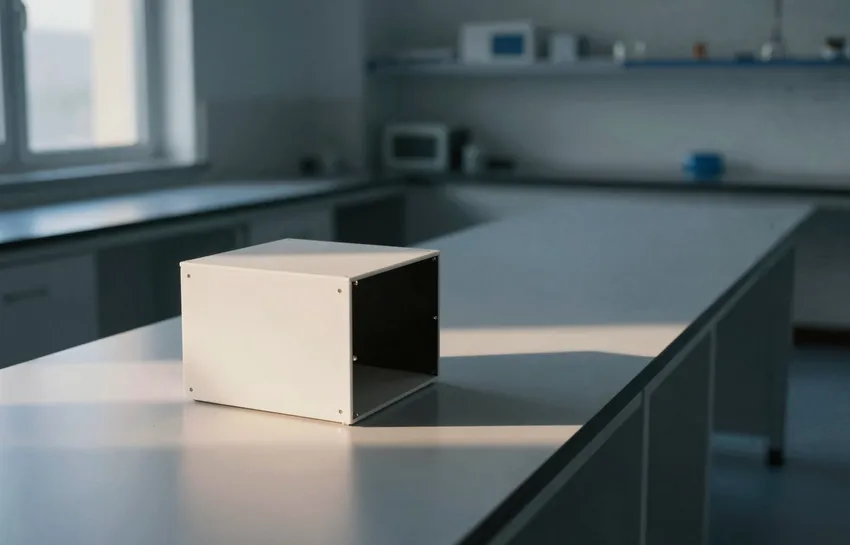
In the mice, something plainer. Put a mouse in a box with a light end and a dark end and a sighted one goes to the dark. It is innate and it does not need to be taught. The treated blind mice did it again: a spontaneous, unprompted preference for the dark side.
That is the measurement. Not a chart of recognised shapes — a small animal choosing the shadow because it could tell there was one.
The part the field will care about most is the lighting. Earlier approaches to this problem have generally needed intense or specialised illumination, which is a serious constraint on anything meant to work in a life rather than in a rig. These compounds worked at levels the authors compare to indoor lighting or an overcast day.
And it is a drug. Not gene therapy, not an implant, nothing permanent installed. Two of the variants, prosthe6-12 and prosthe6-15, performed best. They can be given by injection into the eye, as several existing eye treatments are — or as drops.
The Part Everybody Skips
Three things, and the third is the one that matters.
A mouse choosing the dark is not a mouse reading. It is evidence of light perception driving behaviour, which is a genuine and hard-won result, and it is not the restoration of sight as anyone picturing this would imagine it. The authors do not overstate it. Their own phrasing is that these compounds do not cure blindness.
The eye-movement result is the zebrafish, not the mice. Coverage of this work sometimes lets the two findings blur into one animal. They were separate experiments in separate species.
No human being has been given prosthe6. Not in a trial, not off-label, not anywhere. The authors are explicit that whether the benefit seen in animals would translate to people is unknown. Related photopharmacology has reached clinical testing elsewhere; this compound has not. It is at an earlier stage than that.
We are stating this plainly because a headline about restoring sight travels further than the sentence that qualifies it, and because some of the people who read the headline are waiting for exactly this news about themselves. There is nothing here to ask a doctor for. There is a molecule that works in a mouse.
Why This Is Filed Here And Not With Our Findings
We publish invented research and label it as invented. That is what makes the joke ethical rather than merely convenient, and it is why a real result cannot go in the same drawer with our usual disclaimer attached — printing “none of this is true” underneath a peer-reviewed paper would be a lie pointed in the other direction.
It also means we do not get to be funny about this one. An institute that fabricates everything has exactly one thing it can offer a subject like this, and that is being scrupulous with it.
The Institute did not conduct this research, has no connection to the Institute for Bioengineering of Catalonia, and contributed nothing beyond reading the work carefully and repeating it without embellishment.
Sources
Grow Your Confidence,
Not Your Doubts
Subscribe to receive the Institute's latest unverified findings the moment they exist, and well before the fact-checkers arrive.