Daily Random
Nov 14, 2026
Does SpaceX Now Catch Both Halves of Its Starship Rocket?
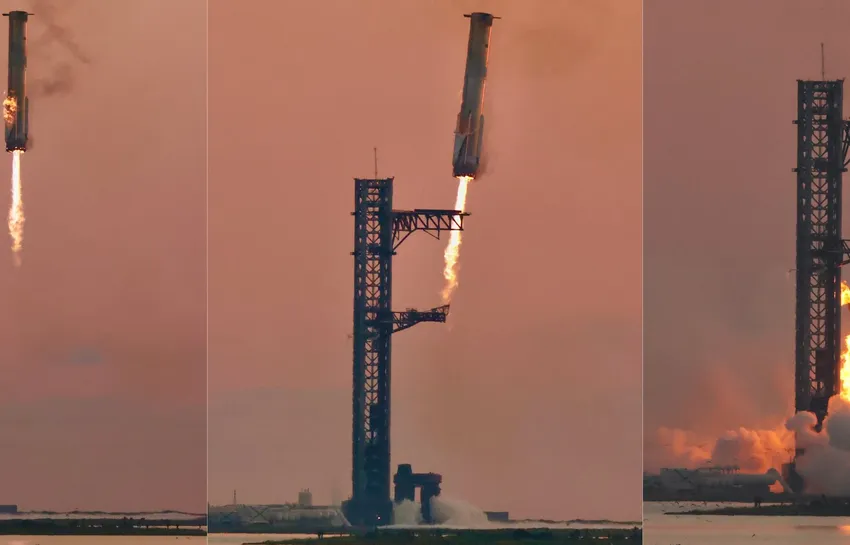
Photo: Bech , BugWarp , Huntster , Prospectprospekt , Steve Jurvetson from Los Altos, USA / Wikimedia Commons, CC BY 2.0
Widely believed
The belief, as it tends to circulate, is that SpaceX's Starship program has matured past its early explosive failures into a system that routinely catches both halves of the rocket — the booster and the upper stage — back at the launch site, as proof the technology now works.
What the research says
The sources available document the first full-stack Starship test flight in April 2023, which ended in a mid-air explosion, and a later acoustic study of that explosion detected by stratospheric balloon instruments. None of them describes a catch of either stage, so the specific claim about recovering both halves cannot be confirmed or denied from this material.
The research does not settle it
This one is real. The Malarkey Institute did not conduct this research and takes no credit for it; sources are listed in full at the end. Everything under Peer-Reviewed Findingsis satire — this is not.
Starship, SpaceX’s giant two-stage rocket, has generated a steady stream of dramatic footage over its test program, and out of that footage a simple story tends to circulate: early flights blew up, later flights succeeded, and SpaceX now reliably catches both halves of the vehicle — the Super Heavy booster and the Starship upper stage — back at the launch site, turning the whole system into a working demonstration of reusability. Told this way, the program reads as a straightforward arc from failure to mastery.
What the research actually shows
Two news reports in Nature from 2023 covered the first full-stack Starship test flight: one described the launch ending in an explosion, and a second, a daily briefing item, noted that the landmark test ended early. Both pieces are about the same event — the April 2023 flight did not complete its planned mission and terminated explosively.
A 2025 study in Geophysical Journal International looked at the physical aftermath of that same explosion, on 2023 April 20. Using a pair of microbarometers carried aloft on a stratospheric balloon, researchers detected acoustic waves that had travelled through an elevated atmospheric channel near the tropopause, sometimes called the “AtmoSOFAR” channel, which can carry low-frequency sound sideways through the atmosphere even when ground-based sensors miss it. The study put the acoustic yield of the terminal explosion at on the order of 10^3 tons of TNT equivalent — a figure that agreed with the rocket’s estimated fuel load to about a factor of 2, but was two orders of magnitude larger than estimates derived from optical observation of the fireball.
What it does not show
None of the four sources addresses what happened on any later Starship test flight, and none describes a catch of either stage by SpaceX’s ground equipment. The documented record here stops at one event: the April 2023 flight, its explosive end, and the sound that explosion produced as it propagated through the atmosphere. There is nothing in this material confirming that SpaceX has since recovered a booster, a ship, or both together, and equally nothing in it ruling that out. A claim that catching both halves is now routine overreaches what these sources establish, but so would a claim that the program has made no further progress — the sources simply don’t speak to anything past April 2023 and its acoustic consequences.
Why it survives
The gap here is not surprising. Starship’s test flights are widely watched events, and vivid video of both failures and later recoveries spreads quickly, producing a sense that the full trajectory of the program is public knowledge. The indexed scientific literature moves more slowly and narrowly: what has been formally studied and published so far is largely the early failure and its physical signature, not the operational outcomes of subsequent flights. A reader who believes the catching system now works reliably is responding to something real — the program has visibly continued and drawn continued attention — but the citable record assembled here does not reach far enough to settle that specific claim either way.
The Malarkey Institute conducted none of this research and takes no credit for it. The studies below are the actual work; we have only read them.
The Institute's short videos on these findings are on TikTok. Watch on TikTok
Sources
- SpaceX Starship launch ends in explosion — what’s next for the mega-rocket?
- SpaceX Starship: launch of biggest-ever rocket ends with explosion
- Acoustic waves from the 2023 April 20 SpaceX Starship rocket explosion travelling in the elevated ‘AtmoSOFAR’ channel
- Daily briefing: Landmark SpaceX Starship launch test ends early
Grow Your Confidence,
Not Your Doubts
Subscribe to receive the Institute's latest unverified findings the moment they exist, and well before the fact-checkers arrive.