Daily Random
Sep 16, 2026
Does the African fish eagle keep to a breeding season?
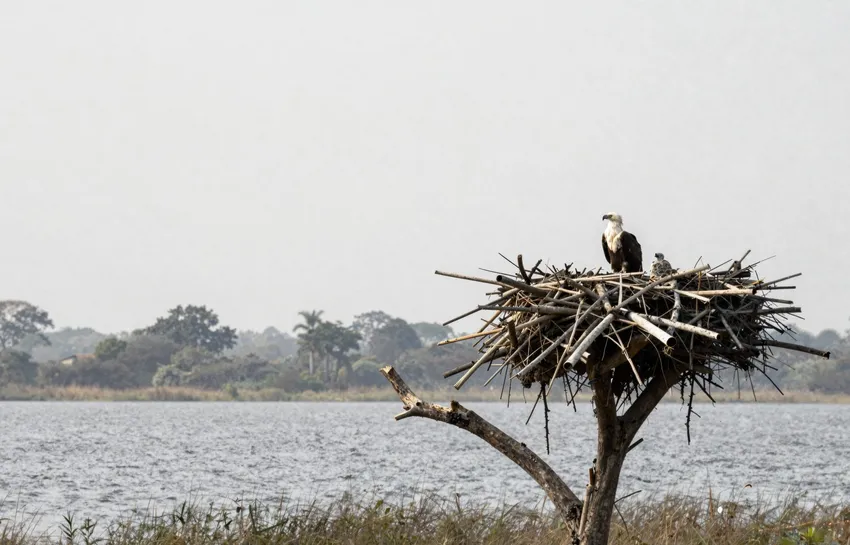
Widely believed
The African fish eagle, the calling bird of the continent's lakes and rivers, is usually introduced as a species with a set breeding season, timed to the drier months when water falls and fish are easier to take, and with young that leave the nest as smaller copies of their parents.
What the research says
A 1986 study in Queen Elizabeth National Park, Uganda, found the species breeding all year round there, with temperature and water level negatively correlated with breeding and social stimulation not important. A 1988 study of nestlings in the same park found young reaching and exceeding adult body weight by fledging, though the wing had not reached adult size. Both studies describe a single park, and the sources do not establish what the species does across its wider range.
The claim is oversimplified
This one is real. The Malarkey Institute did not conduct this research and takes no credit for it; sources are listed in full at the end. Everything under Peer-Reviewed Findingsis satire — this is not.
The African fish eagle is the bird most people picture when they picture African water. A white head and chest, a chestnut belly, a call that carries across a lake at dawn. It is often presented as a kind of emblem for the whole continent, and the profile that circulates with it is tidy: a bird that pairs up, holds a stretch of shoreline, breeds in a fixed season when the water is low and fish are easy to catch, and raises young that leave the nest as scaled-down versions of the adults.
Most of that profile is not what the papers in front of us are about. The papers are about two narrower questions: when the bird breeds, and how its chicks grow. On those two points the published record is more specific than the popular account, and in one respect it points the other way.
What the research actually shows
A 1986 study in African Journal of Ecology followed fish eagles in Queen Elizabeth National Park, Uganda. Its central result is blunt: in that park the species breeds all year round. The authors tested which environmental factors tracked the pattern of breeding and found that only changes in temperature and water level were significantly correlated with it, and that both correlations were negative. They also report that social stimulation, the idea that pairs breed because neighbouring pairs are breeding, is not important in the breeding biology of these birds. The same abstract states that the fish eagle in this area exhibits an annual breeding cycle, so the picture is of a population in which breeding occurs in every month, with a cycle that rises and falls against temperature and water level rather than switching on and off.
A 1988 study in the same journal, from the same park, measured nestling growth. The chicks attained and then exceeded the adult body weights of their respective sexes by fledging time. Their growth curves had the sigmoid shape common to most animals. The overall growth rate was low, averaging 0.077 g/day with a stated spread of 0.017, and the time needed to grow from 10 to 90 percent of the final asymptotic weight was about 42 days. Brood size and hatching order did not significantly affect growth rates; the sex of the chick did. By fledging, the tarsus, femur and humerus had reached adult size. The standard wing had not.
The third paper, a 1958 account in Ibis titled as a study of the habits of the African fish eagle, reaches us as a title only. We cannot say what it reports beyond its subject, and we do not pretend to.
What it does not show
The two Ugandan studies describe one national park. They do not describe the species across its range, and nothing in the provided text says whether fish eagles on other lakes or rivers breed year round, seasonally, or somewhere between. A reader who takes the 1986 result and announces that the African fish eagle has no breeding season anywhere has gone further than the paper does. The abstract itself keeps both statements side by side: breeding in every month, and an annual cycle. Those are compatible, but they are not the same as saying breeding is uniform.
The negative correlation with water level is worth reading carefully. The popular account links breeding to low water because fish are easier to catch. The 1986 abstract reports a statistical association between breeding and changes in temperature and water level; it does not, in the text we have, explain the mechanism, and it does not mention fish availability. The direction of the correlation may be consistent with the popular story, but the paper as summarised does not test the story.
The nestling result also needs its limits stated. The chicks were heavier than adults at fledging, which cuts against the image of a fledgling as a small adult. But the wing was not yet adult size, so a fledgling is also not simply a large adult. The growth-rate figures are averages from a single park in a single study period. Nothing here addresses survival after fledging, diet, pair bonds, or territory, all of which belong to the popular profile and none of which these abstracts touch.
Why it survives
The fixed-season story survives because it is what most large birds do in most places people watch them, and because it is what a visitor sees. Someone who spends a week on a lake in a dry month and sees an active nest will reasonably conclude that this is nesting time. The equatorial setting of the Ugandan park, where temperature and water swing less sharply than in strongly seasonal regions, is exactly the kind of place where the general rule would soften, and exactly the kind of place a general profile tends not to mention. The smaller-copy image of the fledgling survives for a similar reason: a young eagle looks gangly and unfinished, and few people weigh one.
The Malarkey Institute conducted none of this research and takes no credit for it. The studies below are the actual work; we have only read them.
Watch the Institute's video
Watch on TikTok
Sources
Grow Your Confidence,
Not Your Doubts
Subscribe to receive the Institute's latest unverified findings the moment they exist, and well before the fact-checkers arrive.