Daily Random
Sep 20, 2026
Is there a cave of giant crystals deep beneath Mexico? The papers in front of us do not say
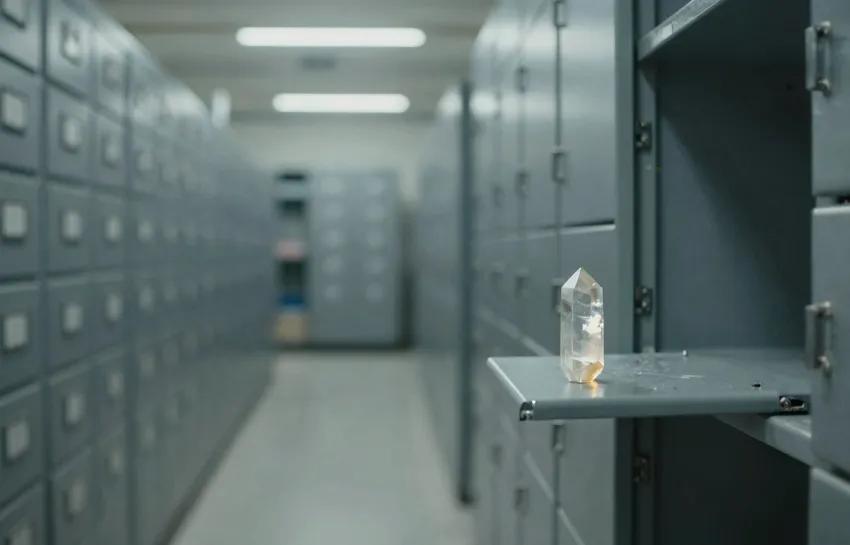
Widely believed
Somewhere deep beneath Mexico there is a natural chamber filled with crystals grown to enormous size, a real place that was reached by accident and is now spoken of as one of the strangest interiors on Earth.
What the research says
The only sources supplied are a pair of title-only 1965 entries in Deep Sea Research and Oceanographic Abstracts on structure beneath the continental shelf of the northeastern Gulf of Mexico. Their titles concern offshore seafloor geology and make no mention of caves, crystals or any underground chamber, so they neither confirm nor deny the belief. On this material the question is unsettled.
The research does not settle it
This one is real. The Malarkey Institute did not conduct this research and takes no credit for it; sources are listed in full at the end. Everything under Peer-Reviewed Findingsis satire — this is not.
The belief travels as a picture rather than an argument. Somewhere deep beneath Mexico, the story goes, there is a natural chamber where crystals have grown to a size that makes a person look small beside them, pale and translucent and packed so tightly that the space between them is the only path through. It is described as hidden for an immense span of time and found more or less by accident. It is told as fact, usually with a photograph, and usually with the remark that it looks like something invented.
We were asked to check this against the published research supplied to us. What follows is what that research can and cannot carry.
What the research actually shows
The material in front of us consists of a pair of entries in Deep Sea Research and Oceanographic Abstracts, both from 1965, both carrying the same title: “Structure beneath continental shelf, northeastern Gulf of Mexico.” They are listed under separate identifiers but are otherwise indistinguishable in the record. Crossref holds no abstract for either. We therefore have a title, a journal, and a year, and nothing else.
The title does establish a few things on its own. In 1965 this journal published work on the geological structure lying beneath a continental shelf. The shelf in question is in the northeastern Gulf of Mexico. That is marine geology: it concerns what sits under the seafloor off a coast, studied from the water. The word “beneath” in the title refers to layers under the shelf, not to a cavity a person could stand in. The word “Mexico” appears only as part of the name of the Gulf.
Neither title mentions a cave. Neither mentions crystals, a mine, a chamber, or any of the features the belief depends on. There is no abstract from which to draw a single measurement. That is the full extent of what these sources say on the subject: nothing directly, and only the general fact that the geology of the Gulf region was under study in 1965.
What it does not show
It would be easy to read the mismatch the wrong way in either direction, so both directions deserve a sentence.
The sources do not confirm the cave. A reader who has seen this belief and wants a paper to point at cannot point at these. They describe an offshore shelf, not an underground interior, and a title alone cannot be stretched to cover a claim it never makes.
The sources also do not refute the cave. This is where the popular correction tends to overreach. Someone who declares the crystal chamber a myth, or an exaggeration, or a doctored photograph, cannot cite these papers any more than the believer can. Absence from a pair of 1965 marine geology titles is not evidence that something does not exist on land. The papers are simply about a different place and a different question.
Nor can the sources speak to any particular figure that gets attached to the story: how long the crystals are, how old they are, how hot or wet the chamber is said to be. None of that is in the text we were given, so none of it can be checked here, and we will not supply numbers the sources do not contain. The honest summary is that the work we can cite does not settle this.
Why it survives
The belief survives because it is a good picture and because it is hard to check. Caves are familiar and crystals are familiar, and a cave made of crystals larger than a person joins two ordinary things into something that feels like it ought to be fiction. That feeling is precisely what makes people repeat it. The place, as told, is deep and remote and reached only through a working mine, which means almost no one who hears about it will ever test it against their own eyes. It lives on retelling.
There is also a plainer reason a marine geology paper ends up beside a cave story. Search for “Mexico” and “beneath” and “structure” and titles like these will surface. They seem to promise underground Mexican geology and deliver seafloor stratigraphy instead. A citation that looks right at a glance is often enough for a story to acquire the appearance of a footnote, and the footnote then travels with the story regardless of what it actually says.
The Malarkey Institute conducted none of this research and takes no credit for it. The studies below are the actual work; we have only read them.
The Institute's short videos on these findings are on TikTok. Watch on TikTok
Sources
Grow Your Confidence,
Not Your Doubts
Subscribe to receive the Institute's latest unverified findings the moment they exist, and well before the fact-checkers arrive.