Daily Random
Sep 19, 2026
Is the Hoba meteorite the largest known on Earth, and does the weight people quote hold up?
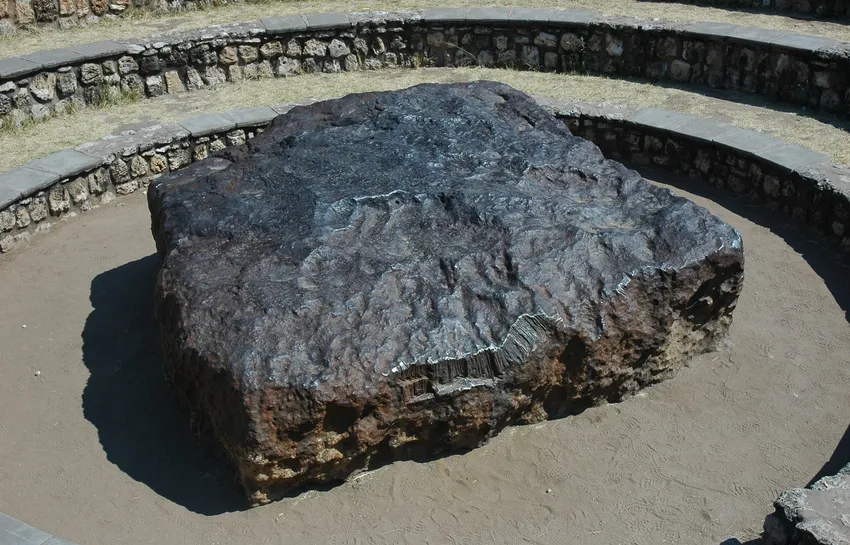
Photo: GIRAUD Patrick / Wikimedia Commons, CC BY 2.5
Widely believed
The Hoba meteorite, a single mass of nickel-iron lying where it was found in southern Africa, is the largest known meteorite on Earth, and it weighs a specific, widely repeated round figure.
What the research says
A 1932 paper in Mineralogical Magazine placed Hoba on record as the largest known meteorite, and later work on its metallurgy offers a physical reason why a high-nickel mass could arrive without shattering. None of the provided text gives a weight, so the tonnage attached to the belief cannot be confirmed or corrected from these sources.
The claim is oversimplified
This one is real. The Malarkey Institute did not conduct this research and takes no credit for it; sources are listed in full at the end. Everything under Peer-Reviewed Findingsis satire — this is not.
The belief travels as a tidy superlative. There is a lump of iron lying in a field in southern Africa, it is the largest meteorite ever found on Earth, it has never been moved, and it weighs a particular round number of tonnes. The number is usually delivered with confidence, as if it had been read off a scale. The story is short, it is memorable, and most of it is old.
What the research actually shows
The oldest of the papers in front of us is a 1932 note in Mineralogical Magazine and Journal of the Mineralogical Society, and its title says the thing plainly: Hoba, in what the paper calls South-West Africa, was the largest known meteorite. The author had, in 1910, placed on record details of the Cullinan diamond, the largest diamond crystal then found, and set out to do the same service for the largest meteorite. The stated motive is worth quoting in spirit: facts about remarkable objects are apt to become exaggerated and distorted, and the accurate data should be written down while they can still be ascertained. So the superlative in the belief has a documented origin, and it comes from a mineralogist who was worried about exactly the kind of inflation that superlatives attract.
A 1979 paper in Journal of Geophysical Research: Solid Earth explains, indirectly, how a mass this large could exist at all. Hoba is a high-nickel ataxite. Charpy V-notch impact specimens cut from it were tested at 77°K and at 195°K. At the colder temperature the metal was fully brittle; at the warmer it was fully ductile, and the transition to complete brittleness was placed below roughly 150°K. The authors note that the ambient temperature of an asteroid is about 150°K, so high-nickel material of this kind stays ductile there and does not fragment in a brittle manner when asteroids collide. They take this as confirming an earlier hypothesis that the failure of high-nickel iron to shatter accounts for the large average size of high-nickel meteorites. In other words, the bigness is not a fluke of the fall; it is a property of the metal. The same paper describes a fine plessitic microstructure with abundant small mineral inclusions, including troilite grains carrying transverse bands of daubreelite.
A 1995 paper in Meteoritics looked at the outside rather than the inside. The oxide layer next to the metal is made mainly of maghemite, magnetite, goethite and lepidocrocite. Most of the nickel from the original metal now sits in those oxides, with the spinel-type minerals holding the largest share, and some nickel has migrated into the limestone in which the meteorite is embedded. Sulfate from oxidised troilite has come out as gypsum. Cobalt, by contrast, stays in the oxides and does not move into the rock, which the authors suggest makes it a useful tracer for oxides of meteoritic origin. This is a description of a large iron object slowly weathering in place.
A 2013 paper in Earth, Moon, and Planets carries the title Towards an Understanding of the Fall Circumstances of the Hoba Meteorite. We have only the title. It tells us the question of how Hoba arrived was still being worked on in 2013, and nothing more.
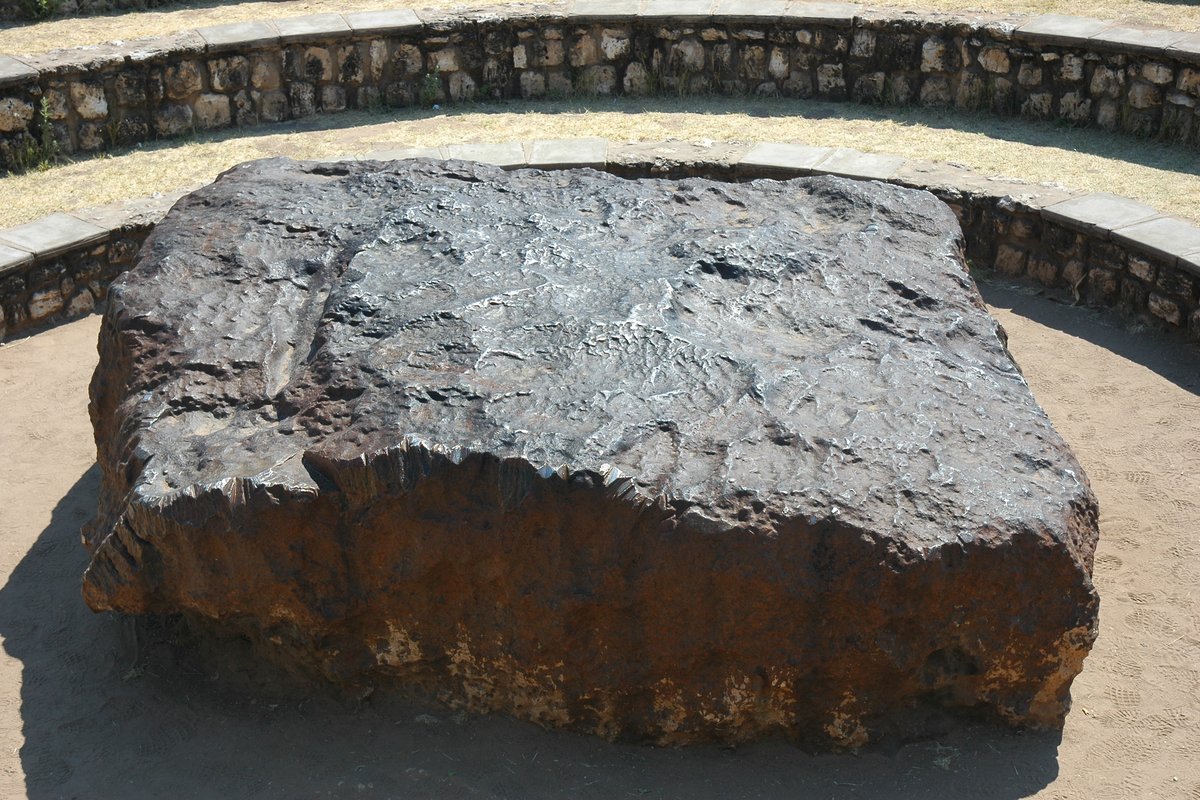
Photo: GIRAUD Patrick / Wikimedia Commons, CC BY 2.5
What it does not show
No paper in front of us states a weight. Not the 1932 record, whose abstract promises accurate data but does not give the figure in the text we hold; not the metallurgical study; not the weathering study; not the 2013 title. The tonnage that circulates may well be right, but it cannot be checked against these sources, and the mineralogist who wrote the 1932 note would be the first to say that a number repeated without a source is exactly the kind of fact that drifts.
The superlative is also a dated one. The 1932 title records Hoba as the largest known meteorite as of 1932. The later papers describe it without ranking it, and nothing here confirms or denies that the ranking still stands. Readers who have met a correction along the lines of “it is actually heavier” or “it is actually lighter than they say” should note that the sources support neither alternative. They give no number at all.
There is a further point the popular version leaves out. The 1995 work shows the surface is oxidising, and that nickel is leaving the metal for the surrounding limestone. The mass is not a fixed quantity. How much has been lost, and over what span, is not something these papers quantify, and we will not guess.
Finally, nothing here settles when or how Hoba fell. The 2013 title frames that as a question still under study.
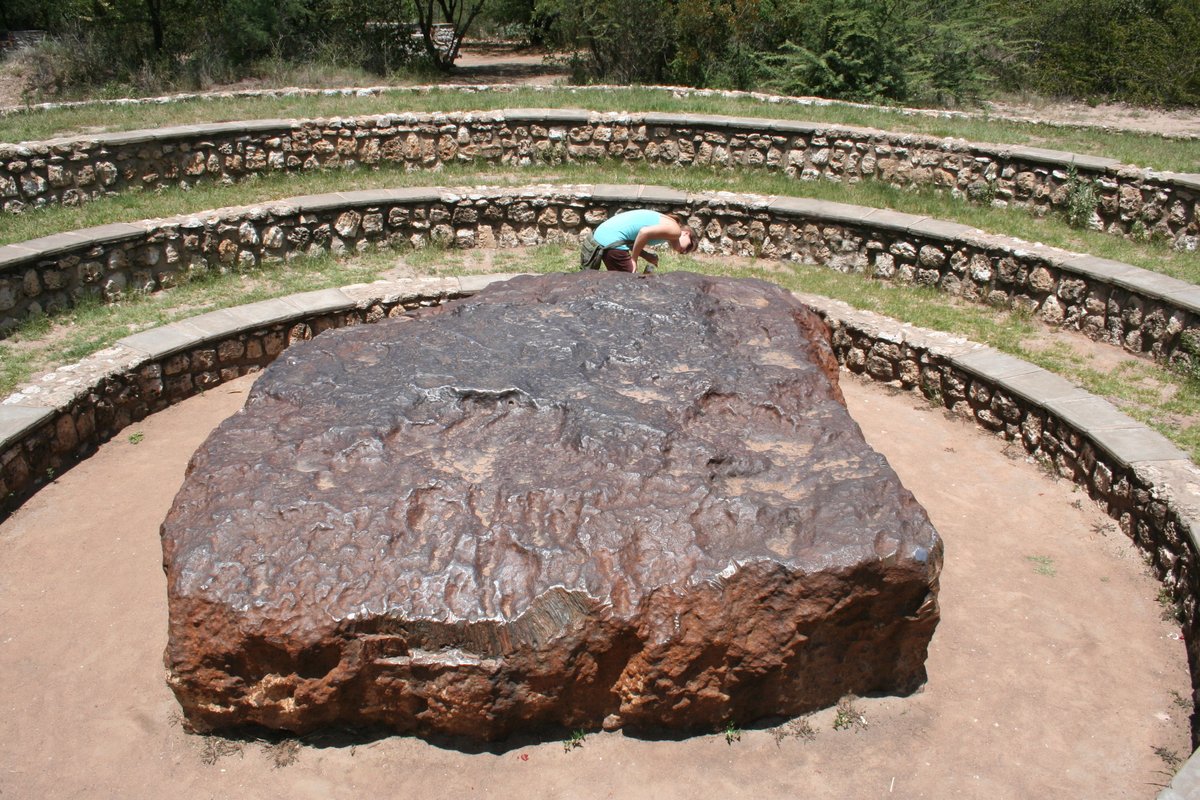
Photo: Compl33t / Wikimedia Commons, CC BY 3.0
Why it survives
A superlative attached to a round number is the most portable kind of fact there is. It fits in a sentence, it invites no follow-up, and in this case its core is genuinely documented: a careful mineralogist in 1932 did record Hoba as the largest known meteorite, and later metallurgy explains why such a mass could hold together. The belief is not a fabrication. It is a true record from 1932 with a number bolted on that the record, at least as we have it, does not supply.
The Malarkey Institute conducted none of this research and takes no credit for it. The studies below are the actual work; we have only read them.
Watch the Institute's video
Watch on TikTok
Sources
Grow Your Confidence,
Not Your Doubts
Subscribe to receive the Institute's latest unverified findings the moment they exist, and well before the fact-checkers arrive.