Daily Random
Oct 07, 2026
Have black-faced lion tamarins been vaccinated?
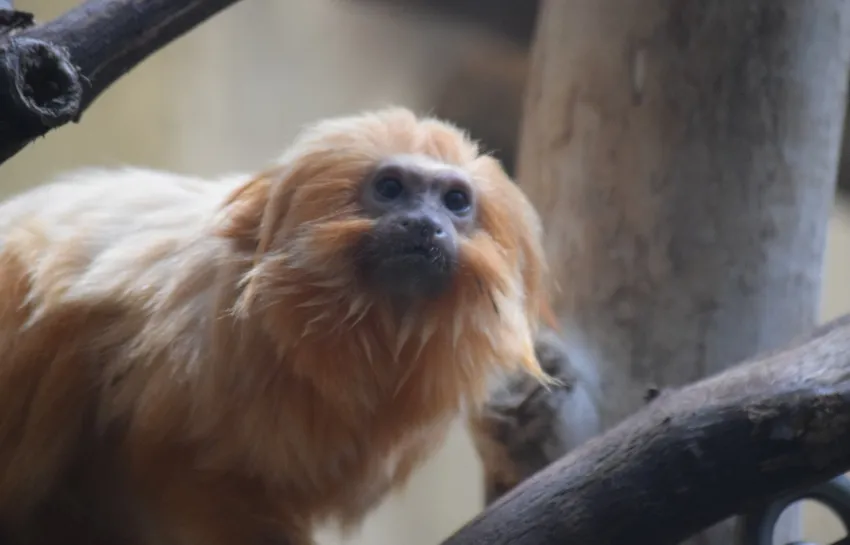
Photo: Vulcansalute / Wikimedia Commons, CC BY 4.0
Widely believed
A claim circulating holds that wild black-faced lion tamarins, being critically endangered, have had conservation workers vaccinate them against disease outbreaks, in the way golden lion tamarins elsewhere in Brazil are known to have received yellow fever vaccination.
What the research says
The available published research on Leontopithecus caissara does not address vaccination at all. The cited studies cover habitat selection and carrying capacity, home range comparison between mainland and island groups, microsatellite genetics for population studies, and an observed association with woodcreeper birds. None reports a vaccination program for this species, so the material in hand provides no basis to confirm or deny the claim.
The research does not settle it
This one is real. The Malarkey Institute did not conduct this research and takes no credit for it; sources are listed in full at the end. Everything under Peer-Reviewed Findingsis satire — this is not.
The black-faced lion tamarin, Leontopithecus caissara, is usually introduced to a general reader the same way it is introduced here: as a critically endangered primate confined to a sliver of coastal Brazil. From there, a belief has circulated that this is one of the primate conservation success stories involving direct medical intervention — that field teams have vaccinated the wild population, often said to be against yellow fever, following the more widely reported vaccination efforts aimed at the related golden lion tamarin. The story has the shape of good news: a species on the brink, a modern tool, a population protected.
What the research actually shows
The published record on this particular species, as represented in the literature available here, is occupied with something else entirely. A 2011 study in Oryx examined habitat selection and estimated carrying capacity for the species, comparing two island groups and two mainland groups. It found that mainland animals favored swamps, inundated areas, and secondary forest, while avoiding submontane forest and urbanized land; island groups instead used tall lowland forest and arboreal restinga. From this habitat work the authors derived a carrying capacity estimate of roughly 700 individuals under current conditions, rising to roughly 1,500 individuals under improved conservation management.
A companion 2011 paper in the American Journal of Primatology compared home range sizes between mainland and island populations using three different spatial-analysis methods. Across a twelve-month study of mainland groups, home ranges came out to 345 hectares by minimum convex polygon, 297 hectares by kernel estimation, and 282 hectares using a newer dissolved-monthly-polygon technique. The paper also noted extensive spatial overlap but limited temporal overlap between mainland groups, interpreted as resource partitioning to reduce competition, and found that the chief difference between mainland and island groups was the number and variety of sleeping sites used.
Two further sources are known here only by title: a 2010 paper in Genetics and Molecular Biology on microsatellite markers useful for population-genetic study of the species, and a 2018 note in Ardeola describing an interspecific association between two woodcreeper species and a group of black-faced lion tamarins. Neither abstract is available, so nothing beyond their stated subjects can be reported.

What it does not show
None of these four sources mentions vaccination, disease surveillance, or any veterinary intervention applied to Leontopithecus caissara. The habitat and home-range papers are concerned with land use and spatial ecology; the genetics paper is concerned with markers for studying population structure; the Ardeola note is concerned with an ecological association with birds. A reader encountering the vaccination claim may be transferring something true of a different, better-known species — the golden lion tamarin — onto this one, or may be extrapolating from the fact that both are small, isolated, and genetically vulnerable populations where disease risk is a real conservation concern. But extrapolation is not evidence. The correction “no, that never happened” would itself overreach, because the provided sources simply do not discuss the question in either direction. This is a case where the honest answer is that the literature in hand is silent, not that it is negative.

Why it survives
The belief has an obvious logic to it. Lion tamarins generally are rare, confined to small fragmented ranges, and frequently discussed in conservation literature using exactly the kind of language found in these sources: carrying capacity, translocation, genetic exchange, management measures. A population numbering in the hundreds, as the Oryx paper estimates, is the kind of population where a single disease event could matter enormously, and readers aware of yellow fever vaccination campaigns among golden lion tamarins have good reason to assume the same approach would be used for a cousin species facing similar risks. The assumption is reasonable. The documentation for it, at least in what is cited here, is not.
The Malarkey Institute conducted none of this research and takes no credit for it. The studies below are the actual work; we have only read them.
The Institute's short videos on these findings are on TikTok. Watch on TikTok
Sources
- Habitat selection by, and carrying capacity for, the Critically Endangered black-faced lion tamarinLeontopithecus caissara(Primates: Callitrichidae)
- Informative microsatellites for genetic population studies of black-faced lion tamarins (Leontopithecus caissara)
- Interspecific Associations between Two Woodcreeper Species (Dendrocolaptinae) and a Group of Black-Faced Lion Tamarins (Primates, Callitrichinae)
- A comparison of the home range sizes of mainland and island populations of black‐faced lion tamarins (Leontopithecus caissara) using different spatial analysis
Grow Your Confidence,
Not Your Doubts
Subscribe to receive the Institute's latest unverified findings the moment they exist, and well before the fact-checkers arrive.