Daily Random
Oct 02, 2026
Are Hercules Beetle Larvae Really 'Absolute Units'?
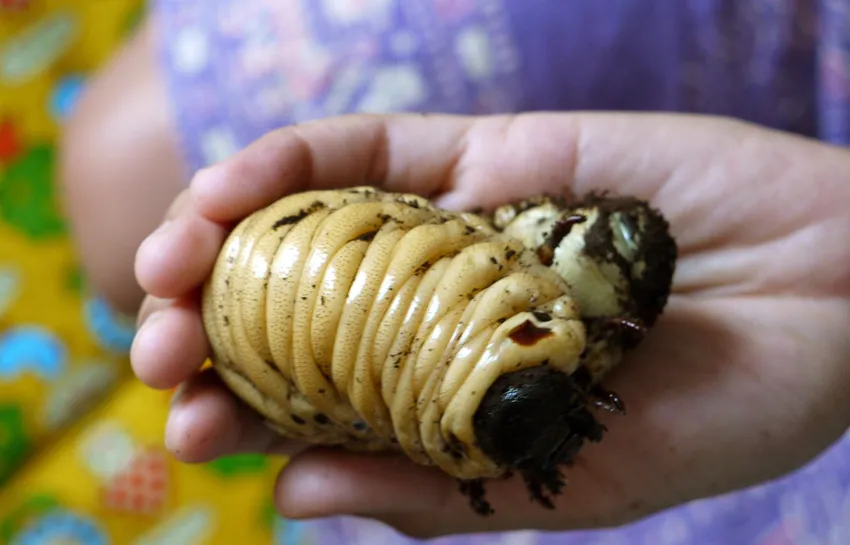
Photo: Novita Estiti from Tokyo, Japan / Wikimedia Commons, CC BY 2.0
Widely believed
The belief circulating holds that Hercules beetle larvae are famously enormous grubs — thick, pale, wrinkled creatures so large and heavy that a picture of one is a textbook 'absolute unit,' supposedly dwarfing what a beetle larva ought to look like.
What the research says
Published research on Dynastes hercules larvae addresses gut microbiology, sex-specific growth response to a fermented compost additive, and the protein and mineral composition of the larvae as a potential food. None of the four sources reports a body length, live weight, or explicit size comparison, so the material available here does not confirm or quantify the popular 'absolute unit' framing, though it does not contradict it either.
The research does not settle it
This one is real. The Malarkey Institute did not conduct this research and takes no credit for it; sources are listed in full at the end. Everything under Peer-Reviewed Findingsis satire — this is not.
A picture of a Hercules beetle larva tends to travel with a caption along the lines of “absolute unit”: a grub thick as a thumb, pale and heavy-looking, presented as proof that some insect larvae get startlingly, almost comically large. The claim is usually left at that — an image, a caption, an implied fact about scale — with no further detail attached.
What the research actually shows
The published literature on Dynastes hercules larvae available here is not about size at all. A 2022 study in the Journal of Applied Microbiology mixed a thermophile-fermented compost into the larvae’s humus at a concentration of 1 percent (w/w), transferred larvae that were about 90 days old into humus with or without that compost, and reared them for 72 days. Only the female larvae showed superior growth under the compost regime; gut bacterial composition was assessed at day 0 and again at day 46 after transfer, and the improved growth tracked with an increase in Mollicutes and a decrease in Gammaproteobacteria. A 2023 follow-up in Insects extended this work, reporting that the compost-fed female larvae showed an increased proportion of potassium ions in the midgut and expressed a juvenile hormone-binding protein gene that was absent in control females, while several genes tied to the defensive system were reduced.
A separate line of work treats the larvae not as pets or research subjects but as a food ingredient. A 2025 nutritional study found that a protein concentrate made from Hercules beetle larva flour reached 51.16 percent protein, 29.87 percent carbohydrate, 4.73 percent crude fiber, and 4.95 percent ash, while whole larva flour carried the highest fat content at 25.76 percent and a potassium level of 94.12 milligrams per 100 grams. A related 2026 study on cured larva flour, comparing oven-dried and toasted preparations with and without condiments, found protein content ranging from 59.09 percent down to 50.07 percent depending on processing, identified 18 amino acids in the flour, 9 of them essential, and measured in vitro protein digestibility ranging from 23.53 percent down to 16.59 percent across the same samples.
What it does not show
None of these four papers gives a body length, a live weight, or any figure that would let a reader judge whether a Hercules beetle larva is unusually large compared with other insect larvae. The growth studies report only relative differences between compost-fed and control larvae, and only in females — not an absolute scale. The nutritional studies describe larvae already processed into flour, where the numbers concern protein, fat, and mineral percentages, not the size of the living animal. So the research gathered here neither substantiates nor undercuts the “absolute unit” description; it simply was not built to answer that question. Anyone treating these papers as confirmation of the meme would be overreaching in the same way the meme itself overreaches when it presents an image as data.
Why it survives
A beetle larva that looks like it belongs to a much larger animal is a genuinely arresting sight, and photographs of one held in a hand invite exactly the kind of caption that spreads. The scientific literature, meanwhile, is occupied with gut microflora, hormone-binding genes, and protein yield for food applications — questions that matter to researchers and food scientists but say nothing about whether the larva is remarkable to look at. The two conversations simply aren’t measuring the same thing, which is enough to explain why a claim about size persists undisturbed by a body of research that never addressed it.
The Malarkey Institute conducted none of this research and takes no credit for it. The studies below are the actual work; we have only read them.
The Institute's short videos on these findings are on TikTok. Watch on TikTok
Sources
- A Thermophile-Fermented Compost Modulates Intestinal Cations and the Expression of a Juvenile Hormone-Binding Protein Gene in the Female Larvae of Hercules Beetle Dynastes hercules (Coleoptera: Scarabaeidae)
- Functional and Nutritional Properties of Protein Concentrates and Isolates from Hercules Beetle Larvae (Dynestes hercules)
- Effects of Curing on the Protein Quality and Amino Acids Profiles of Hercules Beetle (Dynastes hercules) Larvae Flours
- Amendment of a thermophile-fermented compost to humus improves the growth of female larvae of the Hercules beetle Dynastes hercules (Coleoptera: scarabaeidae)
Grow Your Confidence,
Not Your Doubts
Subscribe to receive the Institute's latest unverified findings the moment they exist, and well before the fact-checkers arrive.